Principles of Measurement Systems, 4th edition
By John Bentley
November 2004
Pearson Education
Distrubuted by Trans-Atlantic Publications Inc.
ISBN: 9780130430281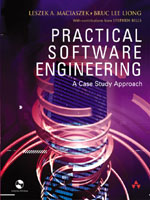
544 pages, Illustrated
$149.50 Paper Original
Description
The distinctive character of this book stems from two endeavors. First, this book is about the way software engineering is done in practice. Second, it is about software engineering for enterprise applications. “Enterprise applications include payroll, patient records, shipping tracking, cost analysis, credit scoring, insurance, supply chain, accounting, customer service, and foreign exchange trading. Enterprise applications don’t include automobile fuel injection, word processors, elevator controllers, chemical plant controllers, telephone switches, operating systems, compilers, and games.” (Fowler, 2003, p.3).
The book is pivoted on one main case-study, a large number of supporting examples, and end-of-chapter problem-solving exercises consisting of case-study exercises and minicases. A particular organization that the case-study, problem-solving exercises and most examples are derived from is a company specializing in advertising expenditure measurement. The book endeavors to give broad software engineering knowledge and to provide background information prior to presenting case-study solutions. However, a distinguishing emphasis of the book is to concentrate on support skills for system design and programming. For given requirements, the book iteratively develops design and implementation models. Case-study, examples and problem-solving exercises are carefully selected to emphasize various aspects of software development as necessitated by unique characteristics of different applications and target software solutions.
The book consists of four parts. Part A (Software projects) discusses software lifecycle, software engineering tools, project planning, budgeting and scheduling, project quality, risk management, and change management. The next three parts (B, C, and D) concentrate on methods, techniques, processes, and development environments of software engineering. The case-study, examples and problem-solving exercises are based on the experience gained from a large ACNielsen project. For pedagogical reasons, industrial problems and solutions have been simplified and re-implemented specifically for the purpose of the book. Occasionally, for comparative purposes, more than one programming environment has been used in presented solutions. All programming code, including code not presented in the text, is available on the book’s website. The code is mostly Java accessing Oracle database.
Features
- Education in mind. The book was written with education in mind. The case-study, examples and problem-solving exercises are not just plainly taken from real-world solutions; they are molded to suit educational needs. Real-world solutions are part of a complex business and software implementation context. That context is likely to be overwhelming and uninteresting to a reader, so it is simplified as much as possible. Presentation of GUI and database designs as well as programming examples eliminates unnecessary dependencies, “information noise” and repetitive tasks.
- Annotated solutions. There are no black-or-white, true-false, zero-one solutions in information systems. Frequently a solution serves a particular purpose and may look plainly wrong when analyzed from a different perspective. Therefore, answers and solutions are carefully annotated.
- Alternative solutions. Sometimes a single solution, no matter how annotated and explained, is not distinguishingly better from other potential solutions. To this aim, alternative solutions are frequently provided and explained.
- Review questions to reinforce the reader’s knowledge by insightful questions to each chapter. The questions are divided into discussion questions and case-study questions.
- Problem-solving exercises to challenge the reader to attempt extended or alternative solutions to the case-study and to the minicases specifically introduced for each chapter.
- Website with complete set of supporting material, including models and programming code (mostly UML, Java and database (Oracle) code). Whenever possible, the files are provided in interchange formats suitable for migration (importing) to other tools and development environments
- Emphasis on principles. There are some well-defined principles of good software engineering and system development. The book identifies and explains these principles and makes linkages to more complete sources of information.
Return to main page of Trans-Atlantic Publications